Background of Battambang Province
According to the temple inscriptions that we have and have found until today before The Angkorian period and period did not tell us which villages and districts existed at that time The one with the name Battambang.
But we also do not dare to conclude that the name Battambang was used or not used in the era. But in the Angkorian and post-Angkorian periods, according to documents, the Khmer masses used the name Battambang district. Why call the name Battambang History written on the inscription did not answer It is known only in the legend, the story of Ta Dambang Kranhong that our Khmer Understood as a story that dates back to the Angkorian era, which explains why Let us call it Battambang or O'Dambang. As for the name Preah Dambang, King Rama I decided to call the village Sangke as Preah Dambang.
Before the Angkorian and Angkorian periods, the western and northwestern parts of the Tonle Sap Lake were The land of Amokpura and the land of Bhimapura. In the Angkorian period, the land or region of Amok Borei flourished due to the fertile soil Can grow rice and other fruits and vegetables with good yield. The Khmer people of that generation came to live in this region, as evidenced by the many ancient temples in the area.
But almost all of those ancient temples collapsed and disappeared, except for Banan, Ek Phnom, Basset, and Stung Banteay. Teay Banteay Chhmar, etc. Tens of thousands of officials and people of that generation built shrines to deities and gods. Other in Hinduism or to the Buddha and other bodhisattvas in Buddhism.
Centuries later, the territory of Battambang province was severely affected by aggression. Cups from the Siamese from the 15th - 16th - 17th - 18th centuries have made the lives of the people That generation of Battambang fell into poverty, ruined families, lost property, and tragedy. . Tra Battambang province under Thai rule.
At the end of the 18th and early 20th centuries, Battambang province fell under Siamese oppression. For more than a century, ruled by the Ben family, it was later renamed the "Immune Family". Six links until 1907.
According to the Franco-Siamese Treaty of March 23, 1907, Siam returned to Cambodia the territory it had occupied. More than a century, that is Battambang, Siem Reap, Angkor, Serey Sophorn and Chongkal by exchange and Trat province and Dach Se (territory Laos) Upper part of the Mekong River. A few months later, His Majesty King Sisowath issued Royal Proclamation No. 66, dated December 6, 1907. Battambang land is divided into three provinces: Battambang, Siem Reap and Serei Sophorn. In 1925, the territory of Battambang province was redistributed into Battambang province and Siem Reap province, in which Battambang province has two districts: Battambang district and Serei Sophorn district.
In 1940, Battambang province had 7 districts: Battambang, Sangke, Maung Russey, Mongkul Borey, Teuk Chor, Serey Sophorn and Bi districts. Gems. In May 1953, the Poipet Administrative Zone was established under Serey Sophorn District. In July 1957, Teuk Chor district was divided into two districts: Preah Net Preah and Phnom Srok. Serey Sophorn district is also divided into two districts: Serey Sophorn and Banteay Chhmar districts. March 1965 Poi administrative area. Pet, established in 1953, is classified as a district called Ochrov district. In July 1965, part of Mong Russey territory was cut into the Koas Kralor administrative area. In March 1966, another new district was established, Thmor Puok, located in Thmor Puok. At the same time, Banteay Chhmar district was removed from Battambang province to be under the jurisdiction of Oddar Meanchey province, which Newly created.
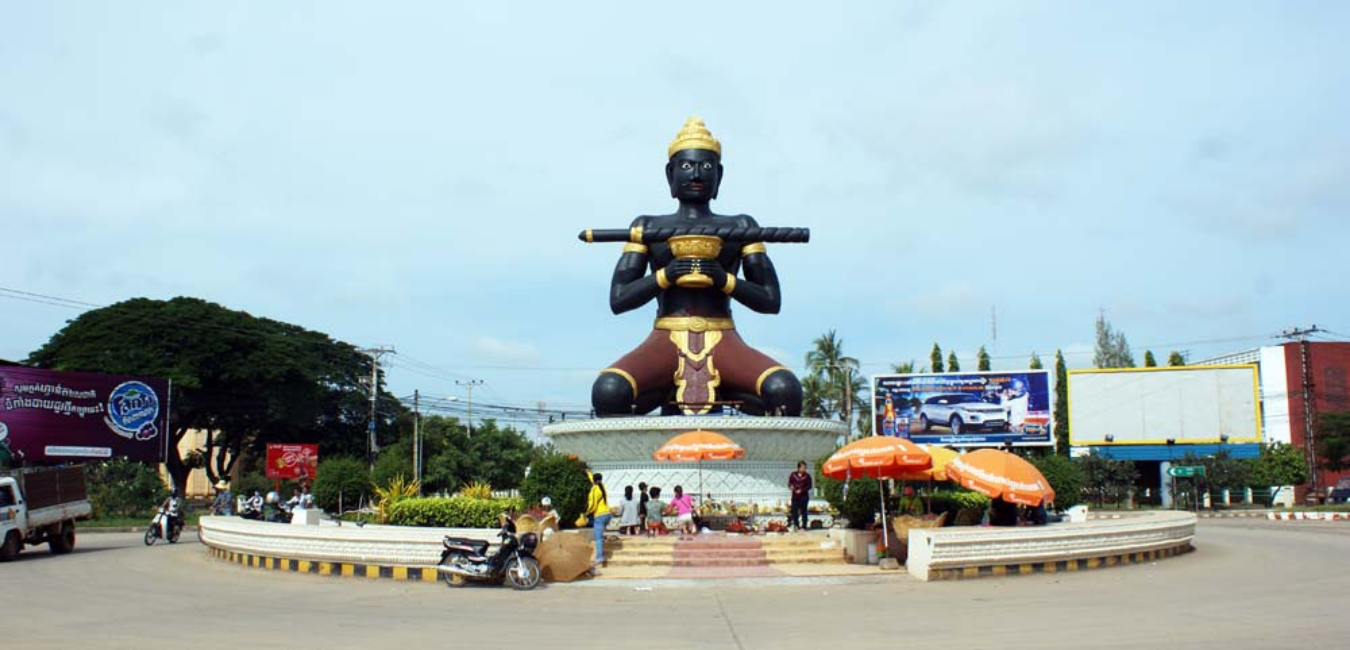
At the beginning of the Khmer Republic, two districts were formed: Banan and Koas Lor. So far, Battambang district has 9 districts: Battambang district, Sangke district, Maung Russey district, Mongkul Borey district, Serey So district. Phorn, Ochrov district, Preah Net Preah district, Banan district, Koas Lor district and 2 administrative areas: Bakprea administrative area and Figs administration. During the killing field regime of 3 years, 8 months and 20 days in Battambang province, as well as other provinces throughout the country, the people The state was evacuated, especially from urban areas to rural and mountainous areas. Battambang, once known as the country's rice barn, became a place of torture, slaughter and starvation at the time. The province did not have clear boundaries, with the then-ruling organization placing Battambang in the region. Northwest and there are 1 area, 3 areas, 4 areas and 5 areas.At that time, some districts were also called, such as Phnom Sampov, Battambang, Mongkul Borei, Sangke, Maung Russey - District 41 - District 42, etc. Battambang Province was liberated from the genocidal regime on the 13th January 1979 The locomotive is called the People's Revolutionary Committee (province-district-town-province-commune-sangkat). Commune / Sangkat People's Committees were first elected in 1983.
From 1989 to 1986, Battambang province had 9 districts, 1 provincial town. In 1986, three new districts were established: Banan, Bavel, and Ek Phnom. Battambang has 12 districts and 9 provincial towns: Maung Russey district, Sangke district, Banan district, Ek Phnom district, Battambang district, Rattan district. Mondul, Mongkul Borey district, Sirisophon district, Preah Net Preah district, Thmor Puok district, Phnom district, and Bavel district.
In 1988, 5 districts were Mongkul Borei, Thmor Puok, Serey Sophorn, Preah Net Preah and Phnom Srok districts. Was cut out to form another new province, Banteay Meanchey. From then until 1993, Battambang province had 7 districts, 1 provincial town and 53 communes and sangkats. 10. After the new constitution, Battambang was renamed Svay Por district. The 10 communes have been transformed into communes, so Battambang has 8 districts and 47 communes.
Currently, Battambang province is located in the northwest of the country, 291 km from Phnom Penh, which borders Pursat province to the east and Tonle Sap Lake to the west of Pailin province And Thailand to the north, Banteay Meanchey to the south, and Pursat to the south. To the west is a 144.8 km long border with Thailand's Chanthaburi, Trat and Sa Kaeo provinces. The province has a total area of 11,748 km 2, 13 districts and 1 city, 92 communes, 10 communes and 809 villages. Number of families: 263,435 families, total population: 1,205,050 people, 602,994 women. Potential labor force from 18-35 years old. 56% Annual population growth 2.3% Density 104.92 people / km2 Agricultural population Mainly 72.20%, average rainfall 960.1 mm / year, weather 13.50 ºc - 41.50 ºc.
The province has one international border gate, the Doung checkpoint (Kamrieng district) and the other four border gates, the 13-kilometer gate (Phnom Land) in Sampov Loun district, O'Rumduol gate in Phnom Proek district, O'Anlok gate (Suon Sum) in Kamrieng district and Chhokka gate (400) in Samlot district. The situation along the Cambodian-Thai border is better cooperation and mutual information Facilitate export-import traffic, especially agricultural products in border districts. GDP in 2016, the economy of Battambang province is about 6,274,083.8 million riels, equivalent to about 1,557.6 million dollars ($ 1 exchange rate = 4028 d) at current prices in 2015.
Compared to 2014, the provincial economy was 5,887,402.5 million riels, equivalent to 1,460.9 million US dollars. The economy grew 4.1% in 2015 compared to 2014, per capita income of $ 1,324.5 in 2015 and $ 1,258.0 in 2014.


